

At a glance
- Jarrah (Eucalyptus marginata) is a dense, hard native hardwood found exclusively in the south-west corner of Western Australia.
- Janka hardness of 8.5 kN, one of Australia’s hardest timbers, comparable to Blackbutt and significantly harder than Tasmanian Oak.
- Naturally resistant to termites and decay, with a Class 2 durability rating for above-ground use. No chemical treatment needed.
- The colour deepens over decades. Fresh salmon-pink to brick-red tones mature into rich burgundy and mahogany with age and diffused light.
- Commercial native harvesting in WA ended permanently on 1 January 2024. Jarrah is now sourced from recycled timber, ecological thinning, and salvage, which has tightened supply and pushed prices up.
- For furniture, it’s one of the finest Australian timbers available: hard enough to last generations, beautiful enough to be worth it.
What makes Jarrah timber worth knowing about?
There’s a reason Jarrah has been called ‘Swan River Mahogany’ since the early days of European settlement. It announces itself the moment you see it: deep reddish-brown tones, a grain that catches the light differently depending on where you’re standing, and a density you can feel the instant you run a hand across the surface.
Eucalyptus marginata grows exclusively in the south-west corner of Western Australia, one of the world’s most biodiverse botanical regions. Its common name comes from djarraly, the Noongar word for the tree. The Noongar people used Jarrah for tools, shelters, and medicine for tens of thousands of years before European settlers arrived and, frankly, took a while to fully appreciate what they had.
Mature Jarrah reaches up to 40 metres tall with trunks up to two metres across, and lives for 400 years or more. Slow-grown trees produce denser, tighter-grained wood, which is exactly why Jarrah’s numbers are so impressive. It’s not hard by accident.
Key characteristics of Jarrah timber
Colour and how it changes over time
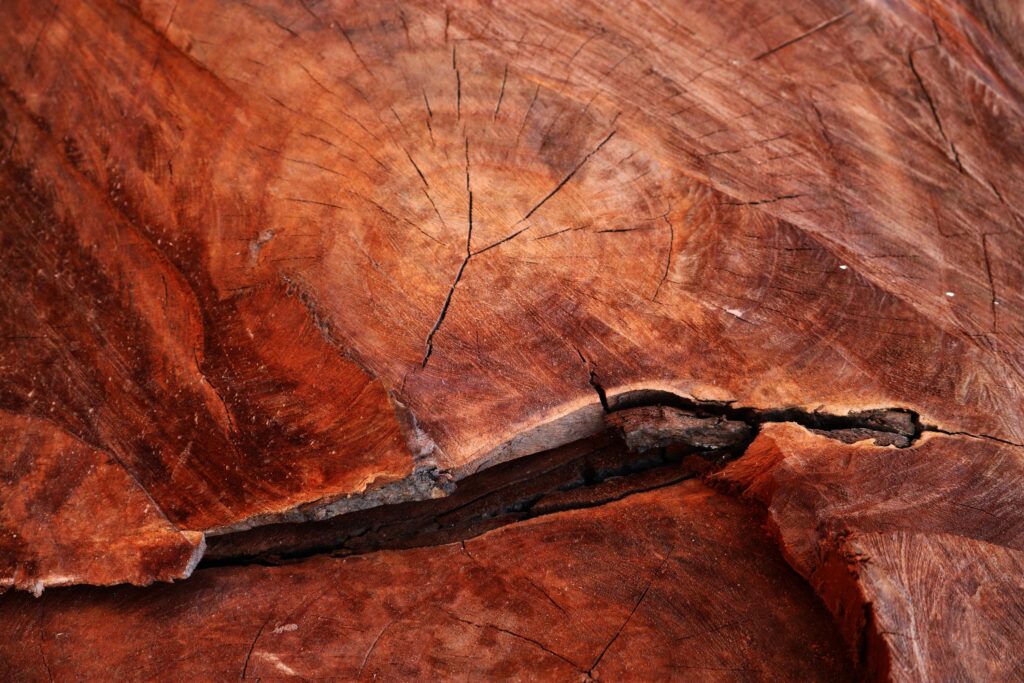
What does Jarrah timber actually look like fresh off the saw? The heartwood ranges from light pink-red through to deep brick red, depending on the board. The sapwood is a clearly defined, narrow band of pale yellow to pink-orange, visually distinct and generally excluded from furniture work.
Here’s what most people don’t expect: the colour gets better with age. With air exposure and diffused light, Jarrah matures into rich burgundy, chocolate, and mahogany tones over the years of use. No stain produces this. No finish replicates it. A well-aged Jarrah table is worth more in a room than it was the day it was delivered.
Worth knowing: Jarrah and strong direct sunlight are a bad combination. Under sustained UV, particularly beneath lacquer finishes, it can turn a flat, powdery yellow rather than deepening the way it should. As furniture maker Evan Dunstone notes in Australian Wood Review, oil finishes and rooms with diffused light are where Jarrah ages properly.
The grain is moderately coarse with an even texture, frequently interlocked or wavy. Occasionally, this produces a fiddleback figure, a rippling, three-dimensional effect that furniture makers genuinely get excited about. Gum veins appear in some boards. No two pieces are identical, which makes colour-matching across a large commission a real skill.
Hardness and density
Jarrah records a Janka hardness of 8.5 kN when seasoned. To put that in context: Tasmanian Oak sits at around 4.9–5.5 kN (the variation reflects the mix of three different eucalypt species sold under that trade name; our full Tasmanian Oak guide breaks down why the numbers vary). Blackbutt, one of the hardest timbers in eastern Australia, comes in at 8.9 kN. Jarrah sits comfortably in that top tier.
Its air-dried density is approximately 820 kg/m³. Freshly cut Jarrah actually sinks in water. That density is felt immediately when you pick up a board, and it’s the reason a well-made Jarrah dining table doesn’t dent when a cast-iron pan is set down without a trivet.
Durability and natural resistance
Under Australian Standard AS 5604, Jarrah is rated Durability Class 2 for above-ground use, with an expected service life of 15–40 years in exposed outdoor conditions. Its heartwood is naturally resistant to termites, a quality that sounds unremarkable until you realise how few Australian species share it. It also carries a moderate rating for marine borer resistance.
No chemical treatment required. That matters both for practical and environmental reasons, and it means Jarrah furniture stays genuinely natural throughout its life.
What is Jarrah timber used for?
Furniture and flooring
Ask what Jarrah timber is used for today, and the honest answer is: mostly furniture and flooring, and for good reason. Its hardness handles daily wear that softer timbers can’t sustain. Its colour and grain give it a presence that manufactured materials and imported species rarely match. Dining tables, desks, beds, sideboards, bedroom suites: pieces built to take real punishment and look better for it.
Flooring is another major application, both new and reclaimed. At 8.5 kN Janka, it handles high-traffic areas without the surface fatigue that shows up quickly on softer flooring timbers.
Outdoor applications
One of Jarrah’s practical advantages over most other furniture timbers is that it works outside. Class 2 durability and natural termite resistance make it genuinely suitable for decking, pergolas, fencing, retaining walls, and outdoor furniture, without chemical treatment.
Compare that to Tasmanian Oak, which has no business being outdoors. Or Marri, which is primarily an indoor timber. Jarrah is one of the few Australian hardwoods that crosses that line cleanly.
A brief, remarkable history
Want to understand how good Jarrah timber really is? Consider what people used it for when they needed the best available material for the job.
Starting in 1887, Jarrah blocks were imported to Britain as a durable, quiet alternative to stone cobblestones. Baker Street, the Strand, and Oxford Road were all paved with WA Jarrah. It proved the hardest-wearing of all wood paving species and resisted absorbing horse urine, which was a genuine engineering consideration for Victorian roads. Millions of railway sleepers were shipped to Africa, Asia, and Britain, where the natural termite and borer resistance made them the preferred choice for tropical rail networks. Network Rail used untreated Jarrah sleepers, expected to last up to 100 years.
In 1898, Fremantle’s High Street was laid with 320,000 seasoned Jarrah blocks. Tested in 1910, they were found practically as good as new.
The timber that paved Victorian London now makes dining tables in Perth homes. Not a bad trajectory.
Why furniture makers value Jarrah
It’s hard enough to earn its keep
A Janka rating of 8.5 kN means Jarrah resists the dents and surface damage that accumulate on softer timbers over the years of real use. There are 40-year-old Jarrah tables still in daily service, their surfaces worn to a patina that only adds to the piece. When you’re working out the real cost of a solid Jarrah dining table against replacing a cheaper alternative every decade, the maths shifts considerably.
The colour is the point
Most materials degrade visibly with age. Jarrah does the opposite. Those initial salmon-pink to brick-red tones deepen over the years into warm burgundy and mahogany, a development that cannot be faked with stain or finish. Antique furniture collectors pay premiums specifically for authentic patina. With Jarrah, that patina builds in your home, from a piece being actually used.
Every board is different
The interlocked grain, occasional fiddleback figure, natural colour variation between boards, and the character of individual pieces mean no two Jarrah furniture items are the same. For anyone who wants furniture with genuine presence rather than the sameness of production-line work, that individuality is the whole point.
Working with Jarrah takes genuine skill
Jarrah demands respect. When fully seasoned, it’s extremely hard. As Australian Wood Review notes, conventional woodworking tools struggle with it, carbide-tipped tooling is essential, and every fastener hole must be pre-drilled, or the timber will split. Broad sections can warp during drying if not handled carefully.
Oil finishes are strongly preferred by experienced Jarrah workers. They draw out the reds and natural warmth of the grain and allow the colour to develop properly over time. Lacquer tends to dull the colour and worsens UV discolouration. Jarrah is almost never stained, because the natural colour is the reason you chose it.
The difficulty of working with Jarrah is part of what separates a handcrafted piece from anything off a production line.
How Jarrah compares to other Australian timbers
| Jarrah | Marri | Tasmanian Oak | Blackbutt | |
| Janka hardness | 8.5 kN | 7.1 kN | 4.9–5.5 kN* | 8.9 kN |
| Colour | Deep red to burgundy | Honey-gold with dark gum veins | Pale straw to pinkish-brown | Golden yellow to pale brown |
| Termite resistant | Yes | No | No | Yes |
| Durability (above ground) | Class 2 | Class 3 | Class 3 | Class 1 |
| Outdoor use | Yes | Limited | No | Yes |
A note on Tasmanian Oak hardness: the commonly cited industry average is 5.5 kN, reflecting a typical blend of the three eucalypt species sold under this trade name. The WoodSolutions figure for the standard commercial mix is 4.9 kN, with individual species reaching up to 7.1 kN depending on which dominates a batch. Both figures appear in the literature; neither is wrong.
Marri is Jarrah’s south-west WA neighbour and, at Jarrimber, one of our most popular timber. Its honey-gold heartwood shot through with dramatic dark kino veins gives it a bold look quite different from Jarrah’s deep, consistent reds. Marri is slightly softer, carries Class 3 durability, and lacks termite resistance, making it primarily an indoor timber. Where Jarrah offers warmth and depth, Marri delivers visual drama. If you’re weighing up the two for a specific piece, we’ve written a detailed comparison of their differences that’s worth a read. You can also explore our Marri furniture collection.
Tasmanian Oak is valued for its light, neutral palette and excellent stainability. Significantly softer than Jarrah at 4.9–5.5 kN, with Class 3–4 durability and no termite resistance, it’s strictly an indoor timber. Right when you want a lighter, contemporary look. Wrong for anything that lives outside. We’ve covered what makes Tasmanian Oak a strong choice for indoor furniture in a separate guide, including its honest limitations.
Blackbutt is eastern Australia’s equivalent in durability terms: marginally harder at 8.9 kN, Class 1 above-ground durability, termite resistant. The structural and decking species of choice in NSW and Queensland. The colour, golden yellow to pale brown, is lighter and more neutral than Jarrah. Technically impressive, but it doesn’t age with the same richness.
Where does Jarrah come from now?
On 1 January 2024, WA’s new Forest Management Plan came into effect and commercial native timber harvesting in the state ended permanently. The announcement had been made in September 2021 under Premier Mark McGowan. In 2025, the WA Parliament passed the Conservation and Land Management Amendment Act 2025, enshrining the ban in law by removing ‘timber production on a sustained yield basis’ as a purpose for State forests. The ban covers Jarrah, Karri, Wandoo, and Marri.
So, where does Jarrah timber actually come from today?
Primarily from recycled and reclaimed sources: timber salvaged from demolished buildings, old bridges, railway sleepers, and heritage structures. Also from ecological thinning operations, where young regrowth forests are managed for health, and from private property clearing. Recycled Jarrah, often milled from old-growth trees felled 50 to 150 years ago, is considered by many craftspeople to be the better material. It’s denser, naturally seasoned over decades, and by some accounts up to 40% stronger than recently harvested timber.
The supply effects have been real. Timber prices have reportedly doubled since the ban, and mills report genuine difficulty sourcing large-diameter logs. What is Jarrah timber worth now compared to five years ago? Considerably more, and that gap will only widen as remaining stocks are drawn down. Jarrah furniture is now drawn from a finite, decreasing resource, and that’s part of why buying well-made pieces today makes more sense than waiting.
At Jarrimber, we source responsibly, working with suppliers who prioritise certified and reclaimed material. Every piece is built to last, because that’s the only approach that makes sense for a timber this rare.
Jarrah in contemporary homes
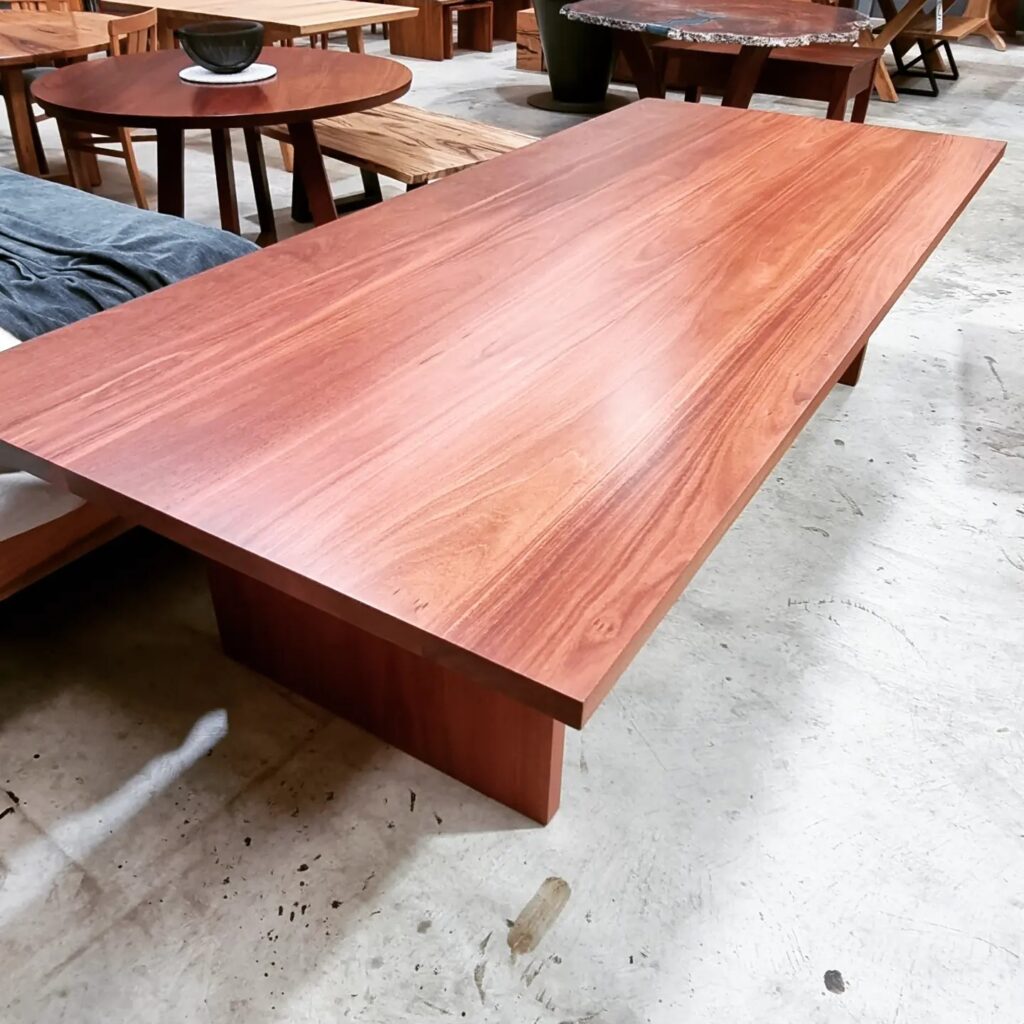
Interior design has shifted back toward warmth and natural materials, and Jarrah sits squarely in the middle of that conversation. After years of bleached, grey-washed timber tones dominating Australian interiors, the appetite for depth and character has returned. Jarrah delivers both.
In a minimalist space, a Jarrah dining table or sideboard does what pale timbers can’t: it anchors the room. It provides the visual weight and richness that pared-back interiors need to feel resolved rather than empty. Against steel, concrete, matte black metal, or brass, Jarrah reads naturally without effort.
Perth’s indoor-outdoor living culture is also relevant here. Most timber species force a choice between beautiful indoors and functional outdoors. Jarrah doesn’t. That dual suitability is a practical advantage specific to WA hardwoods, and it matters for the way most Perth homes actually live.
And there’s provenance worth considering. A piece built from recycled Jarrah salvaged from a Fremantle warehouse or an old WA railway bridge carries a story that no imported timber can match. That connection to place, to Western Australian history, to a material that’s been part of this state since before federation: it’s not a marketing line. It’s just true.
If you’re still wondering, ‘What is Jarrah timber?’ and whether it’s worth the investment, spend five minutes in a room with a well-made piece. The question tends to answer itself.
Explore our handcrafted Jarrah furniture range.
Frequently asked questions
What is Jarrah timber used for?
Jarrah is used for furniture, flooring, decking, outdoor structures, joinery, marine applications, and heritage restoration. Its combination of 8.5 kN hardness, natural termite resistance, and Class 2 durability rating makes it one of the few Australian timbers that works genuinely well both indoors and outdoors without chemical treatment.
Is Jarrah a good timber for furniture?
Yes, and confidently so. The hardness resists the denting and surface wear that softer timbers accumulate over the years of daily use. The colour deepens over decades into richer, warmer tones. Natural termite resistance means no chemical treatment. Well-made Jarrah furniture regularly outlasts the people who commissioned it.
Is Jarrah timber expensive?
It commands a premium, and since WA’s commercial native logging ban took effect in 2024, prices have risen significantly. That said, the cost-per-year calculation over a 30–50 year lifespan compares very differently against furniture that needs replacing every five to 10 years. Recycled Jarrah from heritage demolitions is also available, and many craftspeople consider it the better material.
How does Jarrah compare to Marri?
Both are Western Australian hardwoods, but they’re used differently. Jarrah is harder (8.5 kN vs Marri’s 7.1 kN), naturally termite-resistant, and rated Class 2 for outdoor use. Marri’s honey-gold colour and striking dark gum veins make it the more visually dramatic choice for indoor applications. Our side-by-side guide to Jarrah and Marri covers the practical differences in detail.
Can Jarrah be used outdoors?
Yes, and this is one of its genuine advantages over most other furniture timbers. Class 2 above-ground durability, natural termite resistance, and moderate marine borer resistance make it suitable for decking, pergolas, fencing, and outdoor furniture without chemical treatment. Tasmanian Oak, by comparison, has no outdoor durability credentials at all.
Where does Jarrah come from?
Jarrah grows exclusively in the south-west corner of Western Australia. Since commercial native harvesting ended on 1 January 2024, it’s sourced primarily from recycled and reclaimed timber, ecological thinning operations, and private property clearing. That constrained supply is a real factor in its value, and in why furniture made from it is worth treating as a long-term investment.