


At a Glance
- Tasmanian Oak isn’t a single species. It’s a trade name for three Australian eucalypts, each with slightly different properties.
- Janka hardness sits at 4.9 kN for the commercial mix, ranging up to 7.1 kN depending on which species dominate a batch. Hard enough for daily family life. Not indestructible.
- The colour runs from pale straw through to warm pinkish-brown. It fits into almost any interior style without fighting for attention.
- This is an indoor timber. Full stop. It lacks the natural decay resistance for outdoor use.
- Victoria’s native forest logging ban (January 2024) has tightened supply and pushed prices upward. Tasmanian Oak remains available, but it’s no longer the cheap option it once was.
- Built well and cared for sensibly, a Tasmanian Oak dining table or buffet will outlast the mortgage.
There’s a good chance you’re reading this because you’ve fallen for a piece of Tasmanian Oak furniture somewhere. Maybe in a friend’s kitchen. Maybe in a café with that effortless Scandi-coastal look that Perth does so well. Something about the timber caught your eye, and now you want to know: is Tasmanian Oak good for furniture you’ll actually keep for decades?
We get asked this constantly at the workshop. And after more than 15 years of working with it alongside Jarrah and Marri, our answer is a confident yes — for indoor furniture, it’s one of the best timbers you can choose in Australia. But “best” comes with context. So let’s get into the specifics.
It’s Not Actually Oak
This trips everyone up. Tasmanian Oak has zero relation to European or American oak. The name is pure marketing — adopted decades ago because the timber’s pale colour and clean grain reminded people of true oak.
What you’re actually getting is a blend of three eucalyptus species from southeastern Australia: Eucalyptus regnans (Mountain Ash), Eucalyptus delegatensis (Alpine Ash), and Eucalyptus obliqua (Messmate). According to the Tasmanian Timber industry body, they grow in overlapping regions across Tasmania and Victoria, and sawmills process them together under one trade name.
Here’s why that matters to you. A single pack of Tasmanian Oak boards might contain timber from all three species. Regnans runs lighter and slightly softer. Obliqua is denser, a shade darker, with more prominent gum veins. Delegatensis sits between them with more visible growth rings. So when you notice subtle colour variation across a finished tabletop, that’s not inconsistency. That’s three different trees telling three slightly different stories in the same piece.
One fun fact we like sharing with clients: E. regnans is the tallest flowering plant on Earth. The tallest living specimen in Tasmania stands at roughly 96 metres. Your dining table started life in a forest of giants.
What Does It Look and Feel Like?
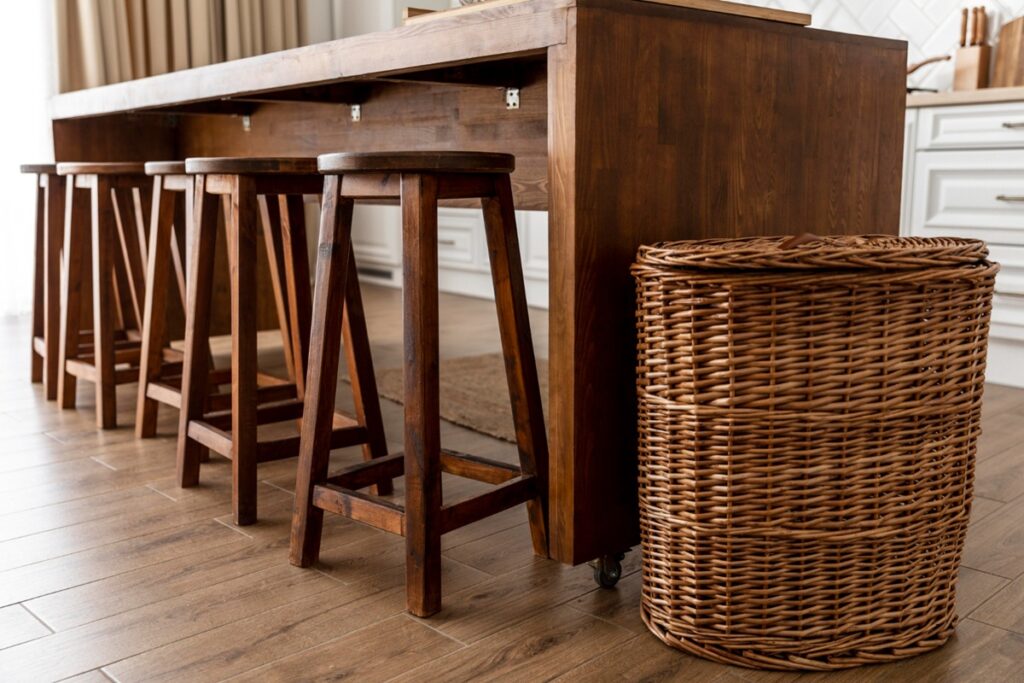
Picture the opposite of Jarrah. Where Jarrah commands a room with deep burgundy warmth, Tasmanian Oak steps back. It lets your artwork, your textiles, your ugly-but-beloved family heirloom on the sideboard do the talking.
The heartwood ranges from pale straw and cream through to light golden-brown, often with a soft pink undertone. Sapwood is nearly identical in tone, which is a quiet advantage — it means wide tabletops and large cabinet panels achieve a consistent look across their full width without obvious colour mismatches.
Grain is straight, open, and even. No bold ray flecks like American White Oak. No dramatic kino veins like Marri. Tasmanian Oak’s beauty is in its restraint. It works with Scandinavian minimalism, modern coastal, mid-century warmth, and rustic industrial without ever feeling like it’s trying too hard.
Gum veins do appear, especially in standard and feature grades — dark streaks of kino resin the tree laid down in response to fire or insect damage. In select-grade boards, they’re minimal. In high-feature grades, they’re the whole point.
One thing to know about colour: it won’t stay this pale forever. UV light breaks down the lignin in the surface layers over time, and the timber gradually shifts toward richer golden-amber tones. Most owners grow to love this. If you’d rather preserve the fresh, lighter look, a water-based polyurethane finish with UV inhibitors will slow the process considerably. Oil-based finishes accelerate it. If you’re wondering whether Tasmanian Oak is good for furniture that needs to keep that freshly milled look, your choice of finish matters as much as the timber itself.
The Numbers That Actually Matter
We could bury you in data sheets. We won’t. Here’s what’s genuinely useful.
Janka hardness: 4.9 kN (per WoodSolutions Australia) for the standard commercial mix. Individual species range from 4.9 kN up to about 7.1 kN, and the commonly quoted industry average of 5.5 kN reflects a typical blend. If you’re still getting your head around how to identify different timber types, Janka is the quickest way to compare. In kitchen terms: plates, glasses, elbows, homework — no problem. A cast-iron pan dropped from bench height? That’ll leave a memory. Use trivets.
Density: approximately 650 kg/m³ (seasoned), ranging up to 780 kg/m³ in Messmate-heavy batches. Heavy enough to feel substantial. Light enough that your cabinet hinges won’t wear out and four people can actually shift the dining table when the in-laws come for Christmas.
Structural rating: F17. That’s one of the highest grades commercial framing timber can achieve. Combined with a medium toughness rating (15–24 Nm), it means the timber absorbs shock without splintering. Chairs, bar stools, bed frames — anything that cops multidirectional force daily — it handles with ease.
Durability: Class 3 above ground, Class 4 in-ground. Translation: 7–15 years outdoors above ground, and just 0–5 years if it touches soil. The sapwood is also susceptible to lyctid borer and the heartwood offers no termite resistance. We’ll say it plainly: keep Tasmanian Oak indoors. For Perth backyards, look at Jarrah or Marri.
Where It Excels as Furniture
So is Tasmanian Oak good for furniture across the board, or only certain types? We’ve built hundreds of pieces in this timber over the years, and its sweet spot is clear.
Dining tables
The even grain lets us edge-join multiple boards into wide, seamless tops that look like a single slab. A Tasmanian Oak dining table anchors a room without dominating it. Sunday roasts, Tuesday homework, birthday cakes with too many candles — the timber takes it all in its stride.
TV units and buffets
If you’ve been searching for a Tasmanian Oak TV unit, there’s a reason this timber keeps coming up. The pale tones reflect light, which makes entertainment and storage furniture feel less bulky in smaller rooms. A Tasmanian Oak TV unit or buffet in a compact Perth apartment opens the space up rather than weighing it down.
Cabinetry and shelving
Moderate weight means doors swing smoothly and shelf brackets don’t groan. The timber also takes veneer beautifully over MDF or plywood substrates for large flat panels where solid wood would be cost-prohibitive.
Chairs
This is where the timber’s toughness and steam-bending qualities pay off. The official Tasmanian Timber species data sheet rates it a good to fair bending timber — a 25 mm section bends to a radius as tight as 100 mm. That means curved backrests and sweeping armrests without the structural weakness of cutting curves from flat stock.
Bedroom furniture
Bedheads, bedside tables, tallboys. The calm, light palette creates a restful atmosphere without competing with your linen and soft furnishings.
We also see clients choosing it for bathroom vanities — though proper sealing is non-negotiable in wet areas.
The Honest Limitations
It will dent
At 4.9 kN, Tasmanian Oak is a medium-hardness timber. Normal life won’t mark it. Careless life will. Dropped cookware, dragged ceramic pots, a toddler with a toy hammer — these leave evidence. Minor dents in oiled finishes can often be raised with a damp cloth and a warm iron. For deeper marks, our stain removal guide covers the options.
It moves
All solid timber expands and contracts with humidity changes. That’s physics, not a defect. But Tasmanian Oak’s shrinkage rates are classified as “Very High” by WoodSolutions, which means it’s more reactive than some species. Tabletops need expansion clips, not rigid screws. Panels need room to float within frames. Every surface needs equal sealing — coat only the top of a table and leave the underside raw, and you’re practically begging it to cup or crack.
This is where the maker matters more than the material. A well-engineered piece accounts for movement from the design stage. A cheap one fights it — and the timber always wins that argument.
It’s not for outdoors
We covered this above, but it bears repeating. No natural termite resistance. No rot resistance. Low in-ground durability. If you want timber furniture on the patio, Jarrah or Marri are the go.
How It Stacks Up Against Other Timbers
Vs Jarrah
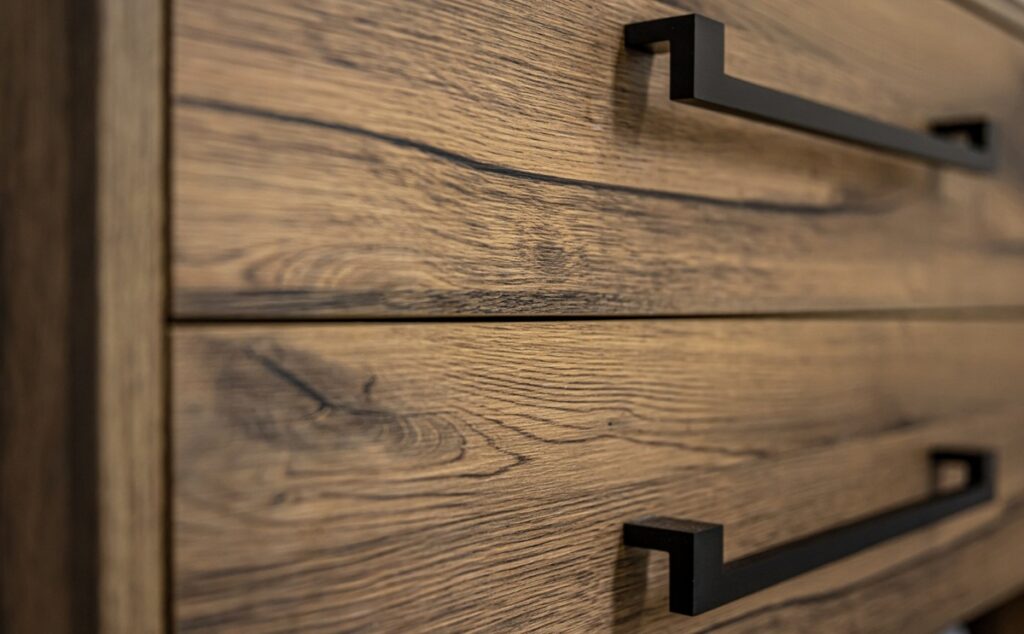
Jarrah is harder (8.5 kN), darker (deep burgundy to chocolate), naturally termite-resistant, and rated Durability Class 2. It goes inside and outside. Tasmanian Oak is lighter, cheaper, easier to machine, and suits contemporary interiors where Jarrah might feel heavy. Different tools for different jobs.
Vs American White Oak
Both compete for the same Scandi-coastal aesthetic. American White Oak is marginally harder (~6.0 kN) with bold ray fleck patterns when quarter-sawn. Tasmanian Oak has a quieter grain and a price advantage as a domestic product. American Oak commands a premium once you factor in shipping and import costs.
Vs Marri
Marri is pure WA drama — honey-gold with dark gum veins, 7.1 kN hardness. It makes a statement. Tasmanian Oak creates a backdrop. They serve completely different design intentions.
Vs Radiata Pine
Pine is softer (~3.2 kN), cheaper, and prone to deep gouging from everyday use. It’s often painted because the surface can’t hold up to visible wear. Tasmanian Oak costs more, but the gap in longevity and appearance is enormous. If you’re weighing the two, our solid wood vs manufactured wood comparison is worth a read.
Sustainability: What’s Shifted
The elephant in the room. Victoria banned native forest logging on public land on 1 January 2024 — six years ahead of schedule. That removed all Victorian-grown Mountain Ash and Alpine Ash from the supply chain overnight, making Tasmania the last major domestic source.
The Tasmanian Government has committed (with bipartisan support) to extending timber contracts to 2040, though negotiations are ongoing and a projected sawlog supply reduction from 2027–28 adds real uncertainty to the long-term picture.
Tasmanian Oak sourced through Sustainable Timber Tasmania carries PEFC certification via Responsible Wood, audited against the AS/NZS 4708:2021 standard for sustainable forest management. That’s a credible baseline — though the certification landscape continues to evolve.
What does this mean for you? Tasmanian Oak remains commercially available. But the days of treating Australian hardwood as abundant and cheap are over. Investing in well-made, long-lasting furniture from certified sources has never made more sense.
Keeping It Looking Good
Full care guides exist (here’s ours), but the basics are dead simple. Dust with a soft dry microfibre cloth. Clean with a damp cloth and pH-neutral soap, then dry straight away. Never use silicone-based furniture polish — it contaminates the surface and makes future refinishing a nightmare.
Use coasters. Use trivets. Rotate objects on the surface periodically so the timber ages evenly under UV rather than developing pale shadow lines where a fruit bowl sat for three years.
Perth’s climate actually works in your favour here. Summer humidity around 38% and winter around 57% sits near the sweet spot for indoor timber. Just be mindful that air conditioning can push interior humidity lower than you’d expect — if drawers start running a touch tight in winter or loose in summer, that’s normal timber movement, not a fault.
For oiled pieces, a re-oil once or twice a year keeps the surface nourished. Our guide to the best oil for wood furniture walks you through it.
The Bottom Line
So — is Tasmanian Oak good for furniture? For anything that lives indoors, it’s a brilliant choice. Strong, beautiful, workable, and adaptable to nearly any interior style. Its limitations are real but manageable: moderate hardness, high moisture reactivity, no outdoor credentials. None of these are dealbreakers when the piece is built properly.
The question that actually determines whether your Tasmanian Oak table lasts 5 years or 50 isn’t the timber. It’s the construction.
At Jarrimber, we’ve been crafting Tasmanian Oak furniture from our Osborne Park workshop for over 15 years. Every piece is engineered for movement, finished for longevity, and joined to stay together for generations. If you’re weighing up your options, we’d love to hear from you.
Frequently Asked Questions
Is Tasmanian Oak real oak?
No. It’s a trade name for three Australian eucalyptus species: Mountain Ash, Alpine Ash, and Messmate. Botanically unrelated to the Quercus (oak) family, despite the visual resemblance.
Is Tasmanian Oak hard enough for a dining table?
Yes. It’s one of the key reasons Tasmanian Oak is good for furniture that sees heavy daily use. The 4.9 kN Janka hardness handles dining life comfortably.
TV units and buffets
If you’ve been searching for a Tasmanian Oak TV unit, there’s a reason this timber keeps coming up. The pale tones reflect light, which makes entertainment and storage furniture feel less bulky in smaller rooms. A Tasmanian Oak buffet or TV unit in a compact Perth apartment opens the space up rather than weighing it down.
Does the colour change over time?
It does. UV light gradually shifts the pale straw tones toward warmer golden-amber hues. Most people grow to love the mellowing. Water-based finishes with UV inhibitors slow the shift if you prefer the lighter look.
Can it go outdoors?
Not recommended. Durability Class 3 above ground (7–15 years) and Class 4 in-ground (0–5 years), with no termite resistance. For outdoor furniture in Perth, Jarrah or Marri are the right call.
Is Tasmanian Oak sustainable?
Certified supply from Sustainable Timber Tasmania carries PEFC accreditation through Responsible Wood. Supply dynamics have tightened since Victoria’s 2024 native forest logging ban, which makes choosing well-made, long-lasting pieces from certified timber more meaningful than ever.H3: How does it compare to Jarrah for indoor furniture?
Different strengths. Tasmanian Oak is lighter, cheaper, and suits contemporary interiors. Jarrah (8.5 kN) is harder, darker, and works both indoors and outdoors. The choice comes down to aesthetic preference and whether you need exterior durability.